If Fairfax County home prices have you wondering how to make ownership work harder for you, house hacking may be worth a closer look. The idea is simple: you live in the home and use a legal rental setup to help offset your housing costs. In Fairfax County, though, the word legal matters a lot, because zoning, permits, and occupancy rules can change what is actually possible. This guide will walk you through the smartest ways to get started, what to verify before you buy, and how to avoid common mistakes. Let’s dive in.
What house hacking means in Fairfax County
In Fairfax County, house hacking usually means buying a home with a legal income component rather than assuming you can create one later. The most practical paths are an interior accessory living unit in a detached home, a room or boarder arrangement in your primary residence, or a legally configured 2- to 4-unit property where you live in one unit.
That distinction matters because Fairfax County generally allows only one dwelling per lot on property zoned for single-family residential housing types unless an accessory living unit, or ALU, is approved. In other words, a lower level with a separate entrance or second kitchen is not automatically a legal second apartment.
Start with the right property type
Interior ALUs in detached homes
For many buyers in Fairfax County, the most realistic house-hacking option is a detached single-family home with an interior ALU. Fairfax County allows one ALU per single-family lot, and the unit must be wholly contained within the house.
The ALU also has to connect to the main home through a finished, temperature-controlled interior passage. If a new exterior entrance is added, it must be on the side or rear of the home.
There are size and use limits too. The ALU cannot exceed 800 square feet or 40% of the principal dwelling, whichever is less, though the county allows the entire basement or cellar to be used up to its July 1, 2021 size. It can have no more than two bedrooms, house no more than two people, and the lot must have the required parking plus one additional space.
Owner occupancy is also part of the framework. Either the ALU or the main dwelling must be owner-occupied, which fits the basic house-hacking model of living on site while generating some income.
Room rental in your primary home
If you do not need a separate unit, room rental can be a simpler entry point. Fairfax County’s household living rules generally allow one family plus up to two roomers or boarders, or up to four unrelated people living together as a single household.
This setup is different from creating a separate dwelling unit. You may be renting a room within your home, not establishing a second legal apartment.
This option can work well for buyers who want to lower monthly costs without taking on a larger renovation or permit process. It can also be more flexible when you are buying a condo, townhome, or single-family home, although private condo rules, lease terms, or bylaws may create extra restrictions.
Buying a legal 2- to 4-unit property
Another path is buying a true duplex, triplex, or fourplex and living in one unit. In Fairfax County, this is not something you typically create inside a single-family property after closing. It usually means buying a property that is already legally multi-unit.
This can be attractive if you want clearer separation between your living space and rental space. It may also create more straightforward income potential, but inventory can be limited, and the legal status of the property should always be confirmed during due diligence.
Why legality matters more than the layout
A finished basement, second kitchen, or private entrance can make a home look perfect for house hacking. But in Fairfax County, appearance and legality are not the same thing.
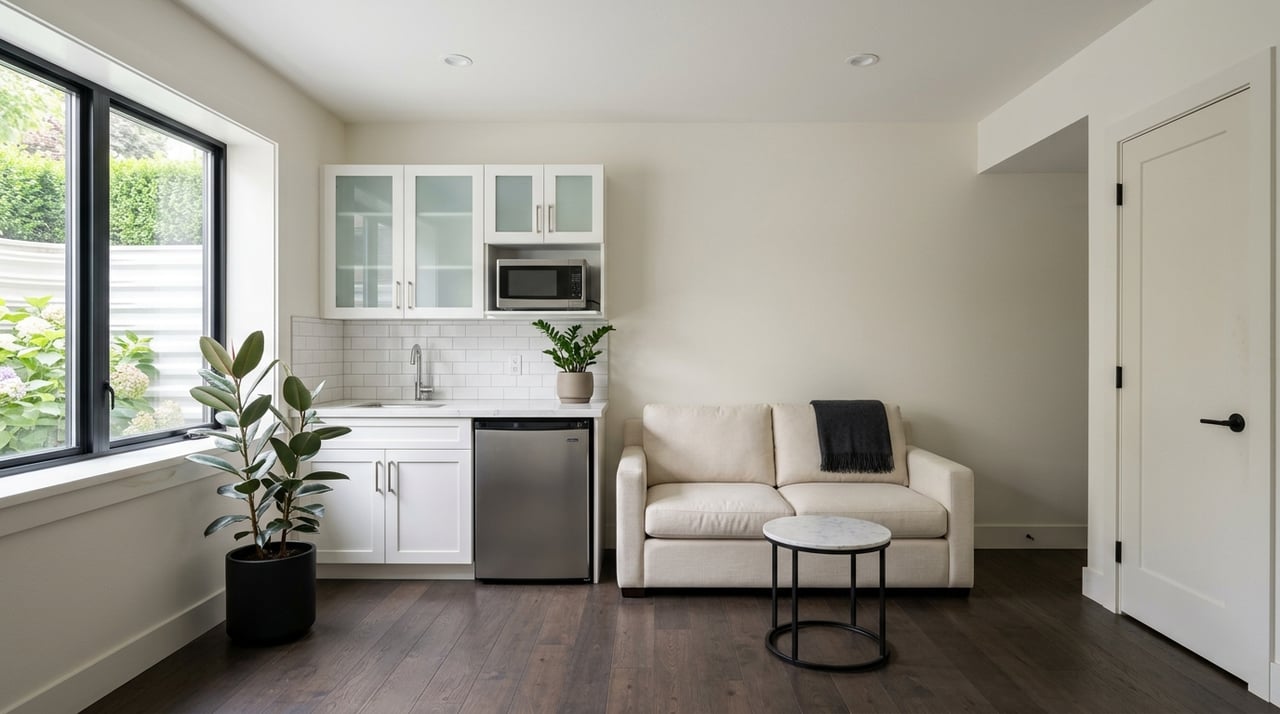
The county specifically notes that a second kitchen does not automatically create a second dwelling unit. That means you should not assume a basement suite, in-law space, or lower-level kitchenette can be rented as a separate apartment just because it exists.
Fairfax County also enforces unauthorized living arrangements. Code Compliance can inspect for illegal extra kitchens, bedrooms, or living spaces that may amount to an unauthorized dwelling and may issue a notice of violation when a property is operating as an unauthorized multiple dwelling.
For buyers, this makes pre-offer and contract-period research especially important. If projected rent is central to your budget, the legal status of the space should be treated as a must-verify item, not a nice-to-have detail.
Permits and approvals to understand
ALU approval basics
If you are considering a detached home with an ALU, know that some interior ALUs that meet county standards can be approved administratively. Other situations require special permit review.
The permit must be recorded before occupancy. Fairfax County also expects ALUs to meet building, safety, health, and sanitation requirements.
That includes practical life-safety items such as interconnected smoke and carbon monoxide detectors where applicable, along with a working fire extinguisher. If the home uses well or septic service, Health Department approval is required before ALU approval.
Renovation and building permit issues
A basement conversion or lower-level suite may require more than one layer of review. In a detached house, a finished basement is generally treated as a residential alteration project for permit purposes.
That sounds straightforward, but the zoning path still matters. A renovation may need both the correct building permit process and zoning approval, depending on what you are creating.
Short-term rental is a separate path
One of the easiest mistakes to make is confusing house hacking with short-term rental rules. In Fairfax County, short-term lodging is regulated separately.
The county allows short-term lodging in residential districts and in all dwelling types, but not in detached accessory structures or accessory living units. It also states clearly that a short-term lodging permit does not authorize the creation of an ALU.
So if you are thinking an Airbnb-style setup can sidestep zoning requirements, it cannot. A short-term rental permit is not a shortcut around the county’s ALU rules.
Financing options that can support house hacking
FHA for a lower down payment start
FHA financing is often one of the most accessible paths for first-time buyers. HUD says FHA loans can be used on 1-4 unit properties, and the down payment can be as low as 3.5%.
That can make FHA especially useful if you plan to live in one unit and rent another in a legal multi-unit property. As always, the property and borrower still need to meet lender and loan requirements.
VA for eligible owner-occupants
For eligible borrowers, VA financing can be a strong option. VA says the home must be for your own personal occupancy, and its home-buying guidance says the benefit can include no down payment unless the lender requires one or the purchase price is above the property’s reasonable value.
That owner-occupant requirement lines up well with house hacking. It does not fit an investment-only plan, but it may be a powerful way to buy a home you live in while offsetting costs with legal rental income.
Conventional financing for multi-unit purchases
Conventional financing can also work well, especially for 2- to 4-unit owner-occupied properties. Freddie Mac says rental income from the other units can be added to your income, subject to underwriting rules.
Freddie Mac also notes purchase financing can go as high as 95% loan-to-value for 2-unit primary residences and 95% for 3- and 4-unit primary residences under its Accept Mortgages framework, with lower limits for manual underwriting. Fannie Mae also allows rental income from a 2- to 4-unit primary residence to be used for qualifying, subject to documentation requirements.
There is an important distinction here. Fannie Mae treats a one-unit home with an accessory unit differently from a legal 2- to 4-unit property, so the financing path for a single-family home with a legal ALU is not the same as the path for a duplex or fourplex.
Roommate or boarder income
If your plan is to rent rooms rather than a separate unit, documented income may still help with qualifying. The Consumer Financial Protection Bureau says rental income from roommates or boarders in a primary residence can be acceptable when properly documented.
Lenders may still review that income conservatively. They may require leases, tax returns, rental history, or other documentation, and they may apply vacancy or maintenance adjustments rather than counting every dollar at face value.
Smart due diligence before you buy
House hacking works best when you verify the details early. Before you rely on rent to make the payment feel comfortable, confirm how the property is classified and what the county actually allows.
A strong due diligence checklist in Fairfax County should include:
- Zoning and permitted unit count
- Whether the space is a legal ALU, a room-rental setup, or a true multi-unit property
- Parking requirements, including the extra parking space needed for many ALUs
- Permit history for basement finishes, additions, or conversions
- Whether owner-occupancy requirements apply
- Whether projected rent is realistic and documentable for financing purposes
- Whether condo or HOA rules add any limits on occupancy or rentals
This is also where calm, local guidance can save you time and money. The right strategy is often not the property with the most obvious basement setup, but the one with the clearest legal path and the least friction.
Best first steps for Fairfax County buyers
If you are just getting started, begin by deciding which version of house hacking fits your comfort level. Some buyers want the separation of a legal 2-unit property, while others prefer a detached home with an interior ALU or a simpler room-rental arrangement.
Next, run your numbers conservatively. Build your plan around legal use, lender documentation standards, and a realistic rent estimate, not a best-case scenario.
Finally, focus your home search on properties that already align with county rules. In Fairfax County, the smartest house-hacking strategy is usually the one that starts with the right property from day one.
If you are exploring homes in Fairfax County and want help identifying properties with realistic house-hacking potential, Brittanie DeChino can help you evaluate your options with clear, local guidance and a thoughtful, low-stress approach.
FAQs
What does house hacking mean in Fairfax County?
- In Fairfax County, house hacking usually means living in a home while using a legal rental component, such as an interior ALU, room rental arrangement, or legal 2- to 4-unit property, to offset housing costs.
Can you add a basement apartment to a single-family home in Fairfax County?
- Maybe, but only if the setup complies with Fairfax County rules for an accessory living unit or another permitted use. A basement with a second kitchen or separate entrance is not automatically a legal second dwelling.
Are accessory living units allowed in Fairfax County detached homes?
- Yes, Fairfax County allows one ALU on a single-family lot with a detached home, subject to standards involving size, layout, parking, owner occupancy, and approvals.
Can short-term rental replace ALU approval in Fairfax County?
- No. Fairfax County treats short-term lodging as a separate use, and a short-term lodging permit does not authorize the creation of an ALU.
Can rental income help you qualify for a Fairfax County house-hacking purchase?
- Yes, depending on the property type and loan program. FHA, VA, and conventional loans may support owner-occupied house-hacking strategies, and lenders may count eligible rental income when it is properly documented.
What should buyers verify before buying a house-hacking property in Fairfax County?
- Buyers should confirm zoning, legal unit status, parking requirements, permit history, owner-occupancy rules, and whether any expected rental income is realistic and documentable for financing.